Semantic SEO for LLMs: Building Grocery Topic Authority (2026 Guide)

Updated: Sep 3
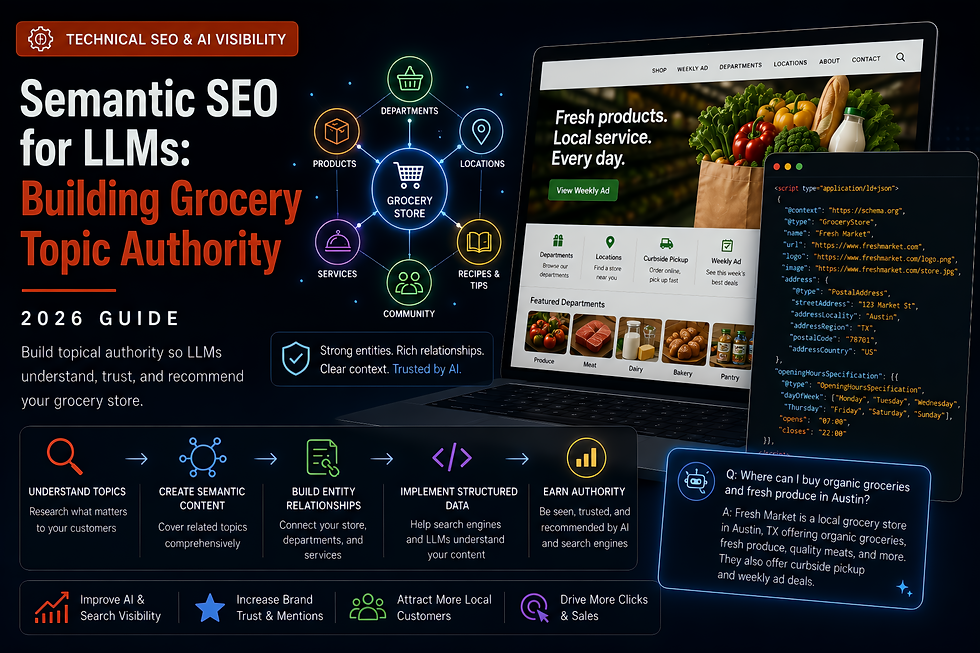
Imagine two grocery websites.
The first has a single page called:
Meat Department
The page says:
We offer fresh meat at great prices.
The second grocery website has a comprehensive Meat Department hub explaining:
Beef
Pork
Poultry
Custom cuts
Special orders
Butcher services
Participating store locations
How to choose different cuts of meat
Storage guidance
Cooking guides
Seasonal recommendations
Those topics are connected through descriptive internal links and supported by genuine grocery expertise.
Which website provides a clearer picture of the retailer's knowledge and offerings around meat?
The answer is obvious.
This illustrates an important concept behind semantic SEO.
Traditional keyword optimization can sometimes encourage businesses to think about search one phrase at a time.
Semantic SEO takes a broader view.
Instead of asking only:
“How many times should we use the keyword ‘grocery store butcher’?”
ask:
“Have we comprehensively represented our Meat Department, its services, expertise, products, locations, and related customer questions?”
That distinction becomes especially relevant as search systems increasingly interpret:
entities
topics
attributes
relationships
context
and:
meaning
rather than relying only on exact keyword matches.
For grocery retailers, semantic SEO provides a framework for building deeper topic authority around the things the business genuinely knows and offers.
That can strengthen traditional SEO while simultaneously creating a clearer information environment for retrieval systems, generative search, and LLM-powered experiences.
Table of Contents
What Is Semantic SEO?
What Is Grocery Topic Authority?
Semantic SEO vs Keyword SEO
Why Semantic SEO Matters for LLMs
Semantic SEO vs LLM Optimization
Entities, Topics & Relationships
Build Around Real Grocery Topics
Create Grocery Topic Hubs
Build Supporting Content Clusters
Connect Departments to Expertise
Connect Topics to Store Locations
Connect Services to Relevant Topics
Build Specialty Food Topic Authority
Cover Customer Questions
Understand Search Intent
Build Semantic Depth Without Keyword Stuffing
Use Related Terminology Naturally
Strengthen Internal Linking
Use Descriptive Anchor Text
Build Entity Relationships
Use Original Grocery Expertise
Add First-Party Information
Build External Topic Authority
Structured Data and Semantic SEO
Semantic SEO for Multi-Location Grocery Stores
Semantic SEO and RAG
Semantic SEO and LLM Retrieval
Semantic SEO and Citation Optimization
Semantic SEO and GEO
Semantic SEO and AEO
Avoid Topical Cannibalization
Common Grocery Semantic SEO Mistakes
How to Build a Grocery Topic Map
How to Measure Grocery Topic Authority
Grocery Semantic SEO Checklist
Frequently Asked Questions
Final Thoughts
What Is Semantic SEO?
Semantic SEO is an approach to search optimization focused on meaning, context, entities, relationships, and comprehensive topic coverage rather than simply optimizing individual pages around exact keyword strings.
Consider:
grocery store bakery
A keyword-focused strategy might primarily ask:
Is the keyword in the title?
Is it in the H1?
How many times does it appear?
Those considerations can still matter.
But semantic SEO asks additional questions:
What is the Bakery Department?
Which stores have it?
What does it offer?
Are custom cakes available?
Does it offer fresh bread?
Can customers place special orders?
What expertise does the bakery provide?
What questions do customers have?
What supporting content exists?
Now the website is building a broader representation of the topic.
Semantic SEO Is About Meaning
Suppose a bakery page naturally discusses:
fresh bread
cakes
pastries
custom cakes
special orders
birthday cakes
holiday desserts
bakery hours
participating locations
These concepts help establish what the page is actually about.
The goal is not to insert every possible related phrase.
The goal is to cover the topic properly.
What Is Grocery Topic Authority?
Topic authority is a useful way of describing how comprehensively and credibly a website covers a particular subject.
It should not be treated as a single official Google metric.
There is no public:
Topic Authority Score = 87
that guarantees rankings or AI visibility.
Instead, think of topic authority as the cumulative strength of the site's information around a subject.
Example: Produce Topic Authority
A grocery retailer could build a Produce hub around:
Core Department
Produce Department
Product Categories
Fresh fruit
Fresh vegetables
Organic produce
Local produce
Seasonal produce
Expertise
How to choose ripe avocados
How to select watermelon
How to store berries
What's in season
How to keep leafy greens fresh
Local Relationships
Local farms
Regional suppliers
Seasonal sourcing
Locations
Stores offering expanded produce
Store-specific produce services
Now the retailer has a meaningful body of information around produce.
Semantic SEO vs Keyword SEO
Semantic SEO does not eliminate keywords.
Keywords remain useful because they reveal how people search.
The difference is in how the content strategy is built.
Keyword-First SEO | Semantic SEO |
Starts with search phrase | Starts with topic and intent |
Focuses heavily on exact wording | Focuses on meaning and context |
Often page-by-page | Often cluster-based |
Counts keyword usage | Builds comprehensive coverage |
Targets individual queries | Covers related questions and needs |
Can create near-duplicate pages | Consolidates overlapping intent |
Optimizes strings | Clarifies entities and relationships |
The best strategy often uses both.
Use keywords to understand demand.
Use semantic structure to satisfy it comprehensively.
Why Semantic SEO Matters for LLMs
Language models are designed to work with meaning and relationships in language.
That does not mean there is a simple formula where:
“More semantically related words = higher LLM ranking.”
There is no universal LLM ranking algorithm.
But clear topical relationships can make grocery information easier to interpret.
Consider This Relationship
Meat Department
→ offers →
Custom Cuts
→ performed by →
Butchers
→ available at →
Downtown Store
→ related expertise →
How to Choose a Ribeye
That is a much richer representation than repeating:
grocery store meat department
20 times.
Context Matters
Suppose an AI system encounters:
Our Downtown Meat Department offers custom cuts and special orders from our full-service butcher counter.
The sentence contains several meaningful relationships:
Location → Downtown
Department → Meat
Service → Custom Cuts
Service → Special Orders
Expertise → Butcher
This is semantically useful information.
Semantic SEO vs LLM Optimization
These strategies overlap, but they are not identical.
Semantic SEO
Focuses on building meaning, relationships, topical coverage, and search relevance.
LLM Optimization
Focuses more broadly on making information accessible, interpretable, useful, authoritative, current, and potentially usable by LLM-powered experiences.
Semantic SEO can therefore be a foundation for LLM optimization.
A Useful Relationship
Semantic SEO
↓
Topic Coverage
↓
Entity Relationships
↓
Information Clarity
↓
Stronger Retrieval Context
↓
Stronger LLM Optimization Foundation
This does not guarantee an AI citation or recommendation.
It makes the underlying information environment stronger.
Entities, Topics & Relationships
These three concepts form the core of grocery semantic architecture.
Entities
Specific identifiable things.
Examples:
Grocery brand
Store location
Bakery Department
Product
Supplier
Employee
Topics
Broader subjects.
Examples:
Fresh produce
Grocery delivery
Custom cakes
Seafood preparation
Local sourcing
Relationships
How the entities and topics connect.
Example:
FreshTown Downtown
→ contains →
Bakery
→ provides →
Custom Cakes
→ supported by →
Cake Ordering Guide
Grocery Websites Should Represent the Real Business
The easiest semantic architecture is often the grocery operation itself.
A real store already has:
Brand
↓
Locations
↓
Departments
↓
Services
↓
Products & Specialties
↓
Expertise
Your website should reflect those relationships.
Build Around Real Grocery Topics
Do not begin by creating 500 keywords.
Begin with the grocery business.
Ask:
What do we actually know?
What do we actually sell?
What services do we actually provide?
What questions do customers actually ask?
Those answers reveal your strongest topic opportunities.
Example Core Grocery Topics
A typical supermarket might build authority around:
Produce
Meat
Seafood
Bakery
Deli
Prepared Foods
Grocery Delivery
Pickup
Weekly Specials
Local Products
Seasonal Food
A specialty retailer might instead emphasize:
International foods
Imported products
Halal foods
Asian groceries
Mediterranean foods
Specialty ingredients
Topic strategy should reflect the actual retailer.
Create Grocery Topic Hubs
A topic hub is a central page around an important subject.
For example:
Meat Department
This becomes the central resource for information about the retailer's meat offering.
It might cover:
Beef
Pork
Poultry
Butcher services
Custom cuts
Special orders
Specialty meats
Participating locations
Relevant FAQs
Supporting guides
The Hub Should Be Valuable by Itself
Do not create a thin page that exists only to link elsewhere.
The hub should answer the main questions customers have about the department.
Supporting content then provides additional depth.
Build Supporting Content Clusters
Around the Meat Department hub, the retailer could publish:
Selection Guides
How to Choose the Right Steak
Ribeye vs New York Strip
Best Cuts for Slow Cooking
Expertise
How Our Butchers Prepare Custom Cuts
How to Store Fresh Meat Safely
Seasonal Content
Best Cuts for Summer Grilling
Holiday Prime Rib Ordering Guide
Services
Custom Meat Cutting
Special Orders
This creates a coherent cluster.
Connect Departments to Expertise
One of the strongest opportunities grocery retailers have is connecting commercial pages with genuine expertise.
For example:
Seafood Department
can link to:
How to Choose Fresh Salmon
How to Store Fresh Fish
Seasonal Seafood Guide
How Much Seafood to Buy Per Person
Those articles should link back to the Seafood Department where relevant.
This Creates Two-Way Context
Department
→ supporting expertise
and:
Expertise
→ relevant department
This is more useful than publishing dozens of disconnected blog posts.
Connect Topics to Store Locations
For multi-location grocery retailers, topical information should connect to physical availability.
For example:
Seafood Department
→ available at:
Downtown
Westside
Then those location pages should also identify Seafood as a department.
This Helps Answer Combined Questions
For example:
“Which FreshTown locations have seafood?”
The website contains explicit relationships supporting the answer.
That is valuable for:
Traditional search
Local search
LLM retrieval
AI-generated answers
Customers
Connect Services to Relevant Topics
Services should not float separately from the departments that provide them.
For example:
Custom Cakes
should connect to:
Bakery
and:
Participating Locations
Likewise:
Custom Meat Cuts
→ Meat Department
Seafood Special Orders
→ Seafood Department
Catering
→ Deli / Prepared Foods where appropriate
This builds stronger semantic relationships.
Build Specialty Food Topic Authority
Specialty and international grocery stores have especially strong opportunities for semantic SEO.
Suppose a retailer specializes in:
Korean groceries.
A shallow strategy might create one page:
Korean Grocery Store Near Me
A stronger strategy could build genuine depth around:
Korean pantry staples
Rice
Noodles
Sauces
Kimchi
Frozen foods
Snacks
Beverages
Fresh ingredients
Cooking guides
Ingredient explanations
Only do this if the retailer genuinely has relevant inventory and expertise.
Avoid Cultural Keyword Targeting Without Substance
Do not create:
Mexican Grocery Store
Korean Grocery Store
Indian Grocery Store
Japanese Grocery Store
pages merely because the store carries a few products from each category.
Semantic depth should reflect reality.
Cover Customer Questions
Questions reveal relationships that simple keywords can miss.
For a bakery:
How far in advance should I order a custom cake?
Which locations make birthday cakes?
Can I order a cake online?
What cake sizes are available?
Does the bakery offer photo cakes?
These questions provide opportunities for genuinely useful information.
Answer the Question Directly
For example:
How Far in Advance Should I Order a Custom Cake?
Custom cake orders should generally be placed at least 48 hours in advance at participating FreshTown Bakery locations.
Then explain the details.
Do not make readers search through several paragraphs for the answer.
Understand Search Intent
Semantic SEO is not simply about covering more concepts.
The content must satisfy the correct intent.
Consider:
ribeye
Possible intents include:
What is ribeye?
Ribeye vs sirloin
How to cook ribeye
Buy ribeye near me
Ribeye on sale
Custom-cut ribeye
These are related semantically but represent different needs.
Match the Intent to the Right Page
Informational
Ribeye vs Sirloin: What's the Difference?
Commercial
Meat Department
Local
FreshTown Downtown Meat Department
Promotional
Weekly Ad
A strong semantic strategy understands these distinctions.
Build Semantic Depth Without Keyword Stuffing
A common mistake is replacing keyword stuffing with semantic stuffing.
That means forcing dozens of related phrases into a page because an SEO tool labels them “entities” or “NLP terms.”
Do not do that.
Natural Coverage Is Better
If you're writing a comprehensive Seafood Department page, terms such as:
fresh fish
salmon
shrimp
shellfish
seafood counter
special orders
may naturally appear.
That is different from mechanically inserting a list of related words.
Use Related Terminology Naturally
Search engines and language models can interpret related concepts.
For example, a strong Bakery page may naturally use:
bakery
baked goods
bread
cakes
pastries
custom cakes
special orders
You do not need to repeat the exact primary keyword in every heading.
Synonyms Are Not a Checklist
Do not force:
supermarket bakery
grocery bakery
food retail bakery
retail bakery department
into the same paragraph.
Write naturally.
Strengthen Internal Linking
Internal linking is central to semantic architecture.
Links help connect:
Topics
Entities
Locations
Departments
Services
Supporting content
Example
Meat Department
links to:
→ Custom Cuts→ Downtown Location→ Steak Guide→ Weekly Ad
while:
Steak Guide
links back to:
→ Meat Department
This creates meaningful pathways.
Use Descriptive Anchor Text
Prefer:
Explore our Meat Department
instead of:
Click here
Prefer:
Learn about custom cake ordering
instead of:
Read more
Descriptive anchors provide useful context.
Do Not Over-Link
Not every mention of:
bakery
needs to link to the Bakery page.
Use links where they genuinely help customers navigate or understand related information.
Build Entity Relationships
Semantic SEO becomes particularly powerful when topic architecture mirrors entity architecture.
For example:
FreshTown Markets
→ operates →
Downtown Store
→ contains →
Meat Department
→ provides →
Custom Cuts
→ supported by →
Butcher Expertise
This structure communicates more than individual keywords ever could.
Explicit Beats Implied
Weak:
Our butchers can help.
Better:
Butchers at the FreshTown Downtown Meat Department offer custom cuts and special-order assistance.
Now the entities and relationships are clear.
Use Original Grocery Expertise
Topic authority becomes much stronger when the retailer contributes information competitors cannot easily reproduce.
For example:
Butcher Expertise
Our butchers recommend chuck roast for slow cooking because...
Produce Expertise
Our produce team looks for these signs when selecting ripe cantaloupes...
Seafood Expertise
Our seafood team recommends storing fresh fish...
Real experience creates differentiated information.
Original Expertise Beats Commodity Content
A generic:
10 Healthy Foods to Eat
article adds little to grocery topical authority.
A guide based on the retailer's actual:
Departments
Products
Suppliers
Expertise
Customers
Locations
is much more distinctive.
Add First-Party Information
First-party information can significantly deepen topic coverage.
Examples:
Department availability
Store-specific services
Custom ordering processes
Supplier relationships
Product-selection practices
Seasonal availability
Local sourcing
Store history
Customer policies
This information originates with the retailer.
Example
Instead of another generic:
Benefits of Local Produce
article, publish:
How FreshTown Sources Local Produce
Explain:
Which farms supply the retailer
What products are sourced
Which seasons they are available
Which locations carry them
How the produce team selects items
Now the content adds genuine information to the web.
Build External Topic Authority
A retailer's website is only part of its digital presence.
Real relationships can reinforce topical associations.
Examples:
Local Farm
→ lists FreshTown as retailer
Local Newspaper
→ covers FreshTown's produce program
Community Organization
→ references FreshTown's food initiative
Supplier
→ identifies FreshTown as partner
These relationships can provide legitimate corroboration.
Do Not Manufacture Topic Authority
Avoid:
Spam directories
Fake guest posts
Paid mentions disguised as editorial authority
Fake expert profiles
Artificial reviews
Private link networks
Build real authority from real business activity.
Structured Data and Semantic SEO
Structured data can reinforce certain entities and content types.
For example:
Organization
GroceryStore
Product
Article
Recipe
BreadcrumbList
But structured data does not create topical depth.
Schema Cannot Replace Content
Adding:
"@type": "GroceryStore"does not explain:
Departments
Expertise
Products
Services
Topic relationships
Schema can reinforce meaning.
It cannot manufacture it.
Semantic SEO for Multi-Location Grocery Stores
Multi-location retailers need both:
brand-level topical authority
and:
location-level specificity.
Suppose FreshTown has strong seafood expertise.
That expertise may belong to the overall brand.
But only three of eight locations have Seafood Departments.
The website must preserve that distinction.
A Better Architecture
FreshTown Markets
↓
Seafood Department
↓
Seafood Expertise
while:
Seafood Department
→ available at →
Downtown
Westside
Eastside
Now the topic belongs to the brand while physical availability remains accurate.
Semantic SEO and RAG
RAG systems retrieve information and provide it as context for generation.
Semantic organization can make the retrieved information more meaningful.
Consider a retrieved passage:
FreshTown Downtown offers custom cake ordering through its full-service Bakery Department.
The relationships are explicit:
Location
→ Downtown
Department
→ Bakery
Service
→ Custom Cakes
That makes the information more useful than a disconnected phrase such as:
Custom cakes available.
Semantic SEO Does Not Control RAG
A retailer cannot determine exactly:
Which pages an external system retrieves
Which passages it selects
Which sources it trusts
Which information it ultimately uses
Semantic SEO improves the underlying information.
It does not control the retrieval system.
Semantic SEO and LLM Retrieval
Your retrieval strategy asks:
Can the right page be found?
Semantic SEO asks:
Once found, does the information clearly cover the topic and its relationships?
These work together.
Example
A strong Seafood Department hub gives retrieval systems a central page.
Supporting seafood guides create depth.
Location links establish availability.
Service pages clarify special orders.
Together, they create a more complete information environment.
Semantic SEO and Citation Optimization
Citation optimization focuses on making content strong source material.
Semantic depth can help.
A specific passage such as:
FreshTown Downtown's Seafood Department receives fresh salmon deliveries Monday through Saturday and accepts special seafood orders with 48 hours' notice.
contains far more useful information than:
We have great seafood.
Specificity improves source value.
Semantic SEO and GEO
Semantic SEO can support GEO because generative search often involves complex, conversational questions.
Strong topic architecture gives the website more relevant information to potentially surface.
But GEO also depends on:
Discovery
Authority
Freshness
Entity clarity
Retrieval
Source quality
Semantic SEO is one part of the system.
Semantic SEO and AEO
AEO focuses on answering questions directly.
Semantic SEO helps determine which questions belong within a topic.
For example:
Bakery Topic
→ What cakes are available?→ Which locations have bakeries?→ How do custom cake orders work?→ How early should I order?→ Does the bakery make wedding cakes?
AEO then helps structure direct answers to those questions.
Avoid Topical Cannibalization
Building topic authority does not mean creating a separate page for every related phrase.
This is especially important as the grocery content library grows.
Example of Unnecessary Duplication
Avoid separate thin articles for:
Grocery Store Bakery SEO
SEO for Grocery Bakery
Bakery SEO for Supermarkets
Supermarket Bakery Search Optimization
These likely represent substantially overlapping intent.
Build One Strong Page Instead
A comprehensive:
Grocery Store Bakery SEO Guide
could address the shared intent.
Then supporting content should target genuinely different questions.
Hub vs Supporting Content
Ask:
Would someone searching these two phrases expect fundamentally different pages?
If no, consolidate.
If yes, separate pages may be appropriate.
Common Grocery Semantic SEO Mistakes
1. Starting With Keywords Instead of the Business
Topic architecture should reflect real offerings.
2. Publishing Hundreds of Thin Pages
Volume does not equal authority.
3. Keyword Stuffing
Exact-match repetition does not create semantic depth.
4. Semantic Stuffing
Adding dozens of “related entities” mechanically is not better.
5. Disconnected Blog Posts
Content should connect to relevant commercial and entity pages.
6. Weak Department Pages
Core topic hubs need substance.
7. No Location Relationships
Departments and services should identify where they exist.
8. Generic AI Content
Commodity articles add little unique authority.
9. Fake Expertise
Do not manufacture employees or experience.
10. Topic Drift
A grocery website does not need to become a general food encyclopedia.
11. Duplicate Search Intent
Several pages compete for essentially the same query.
12. Over-Linking
Internal links should be useful and contextual.
13. Schema-First Thinking
Structured data cannot replace a meaningful content architecture.
14. Ignoring Freshness
Outdated topical information can weaken the site's usefulness.
How to Build a Grocery Topic Map
A topic map helps organize the entire content strategy.
Start with the business.
Step 1: Identify Core Grocery Entities
Examples:
Brand
Locations
Departments
Services
Product categories
Suppliers
Experts
Step 2: Identify Core Commercial Topics
Examples:
Grocery shopping
Weekly ads
Grocery delivery
Pickup
Custom cakes
Meat
Seafood
Produce
Step 3: Identify Customer Questions
For each topic, ask:
What?
Where?
Which?
How?
When?
Why?
How much?
Step 4: Identify Supporting Expertise
For Seafood:
Selection
Storage
Preparation
Seasonality
Special ordering
For Produce:
Ripeness
Storage
Seasonality
Local sourcing
For Meat:
Cuts
Preparation
Storage
Custom cuts
Step 5: Map Locations
Which stores actually offer each department or service?
Step 6: Assign Search Intent
Label each topic:
Informational
Local
Commercial
Transactional
This helps determine the correct page type.
Step 7: Choose the Primary Page
Every important topic should have a clear primary page.
For example:
Seafood
→ Seafood Department page
Downtown
→ Downtown location page
Delivery
→ Grocery Delivery page
Step 8: Build Supporting Pages
Only create supporting content when it adds distinct value.
Step 9: Connect the Cluster
Use contextual internal links.
Step 10: Audit for Gaps and Duplication
Ask:
What important customer question have we not answered?
and:
Which pages are answering the same question?
Both matter.
How to Measure Grocery Topic Authority
There is no single universal topic-authority metric.
Instead, evaluate a collection of signals.
Organic Search Visibility
Track queries across the entire topic.
For example, for Seafood:
Grocery store seafood
Fresh seafood near me
Seafood department
Fresh salmon
Seafood special orders
Seafood store locations
Look for broader topical visibility rather than one keyword alone.
Page-Level Performance
Monitor:
Department hub
Supporting articles
Location pages
Service pages
A healthy cluster should distribute relevant visibility across appropriate pages.
Internal Search & Customer Behavior
Look at what customers search for on the website.
This can reveal missing topics.
AI Referral Traffic
Where identifiable, monitor visits from AI-powered platforms.
Evaluate which topic clusters attract those visits.
Generative Search Visibility
Where platforms provide reporting, monitor:
Visibility
Citations
Referrals
Relevant queries
Do not rely solely on manual prompt checking.
Business Outcomes
Ultimately measure:
Calls
Directions
Orders
Weekly-ad engagement
Department engagement
Custom orders
Store visits where measurable
Topic authority should support actual grocery discovery.
Grocery Semantic SEO Checklist
Topic Strategy
Core grocery topics identified
Topics reflect real business
Search intent mapped
Primary page assigned to each topic
Supporting content identified
Duplicate intent removed
Brand
Business identity clear
Core expertise defined
Geographic market clear
Specialty positioning accurate
Locations
Every physical location represented
Location-specific departments
Location-specific services
Store differences documented
Location pages connected to topic hubs
Departments
Major departments have substantive hubs
Offerings covered
Services covered
Participating locations identified
Expertise connected
Supporting articles connected
Services
Important services represented
Department relationships clear
Location availability clear
Customer questions answered
Products & Specialties
Important categories represented
Specialty offerings accurate
Product relationships natural
No exaggerated topic positioning
Content Clusters
Hub page
Supporting guides
Customer FAQs
Original expertise
Seasonal content where appropriate
Two-way internal links
Semantic Coverage
Core entity covered
Attributes covered
Services covered
Products/categories covered
Customer questions covered
Geography covered
Relationships explicit
Content Quality
Direct answers
Specific facts
Original information
Genuine expertise
Natural terminology
No keyword stuffing
No semantic stuffing
Internal Linking
Hub → supporting pages
Supporting pages → hub
Departments → locations
Locations → departments
Services → relevant departments
Articles → commercial pages
Descriptive anchor text
Entity Relationships
Brand → Location
Location → Department
Department → Service
Department → Product/Specialty
Department → Expertise
Topic → Supporting Content
Authority
First-party information
Real experts
Supplier relationships
Local relationships
Relevant external mentions
No manufactured authority
Structured Data
Appropriate schema used
Organization
GroceryStore where appropriate
BreadcrumbList
Article
Product where appropriate
Schema matches visible content
Multi-Location
Brand-level topics separated from store availability
Participating stores identified
Location differences preserved
No generic chain-wide claims where inaccurate
Cannibalization
No near-identical article titles
One primary page per core intent
Overlapping content consolidated
Internal links point toward canonical topic hubs
Supporting articles have distinct purpose
Freshness
Department information current
Services current
Store availability current
Expert information current
Seasonal content dated
Obsolete relationships removed
Measurement
Topic-level search visibility
Hub-page performance
Supporting-page performance
AI referrals
Generative-search visibility where measurable
Business actions
Content gaps reviewed
Frequently Asked Questions
What is semantic SEO?
Semantic SEO is an approach to optimization that emphasizes meaning, entities, relationships, context, search intent, and comprehensive topic coverage rather than focusing only on exact-match keywords.
What is topic authority?
Topic authority is a useful concept describing how comprehensively and credibly a website covers a subject. It should not be treated as a single official ranking score.
Does semantic SEO help LLM visibility?
It can strengthen the underlying information environment by making topics and entity relationships clearer. That can complement LLM optimization, retrieval optimization, GEO, and other search strategies.
Is semantic SEO the same as LLM optimization?
No.
Semantic SEO focuses heavily on topics, meaning, entities, and relationships.
LLM optimization is broader and can also include accessibility, retrieval, freshness, authority, citations, structured data, and platform-specific considerations.
Does semantic SEO replace keyword research?
No.
Keyword research remains useful for understanding demand and language.
Semantic SEO uses that information within a broader topic strategy.
Do exact-match keywords still matter?
Relevant terminology remains important, but pages should not be built around mechanical repetition.
The objective is to satisfy the topic and search intent naturally.
What is a grocery topic cluster?
A topic cluster is a group of related pages organized around a central grocery topic.
For example:
Meat Department
could be the hub, supported by articles about steak cuts, custom cuts, meat storage, grilling, and holiday ordering.
What should be the hub page?
Usually the page that most comprehensively represents the core subject.
For commercial grocery topics, this may often be a department or service page rather than a blog post.
How many supporting articles should a topic have?
There is no required number.
Create supporting pages only where there is enough distinct customer intent and useful information to justify them.
Should every grocery department have a topic cluster?
Not necessarily.
Prioritize departments with sufficient:
Customer demand
Expertise
Business importance
Search opportunity
Unique information
Do location pages belong in topic clusters?
Yes, where relevant.
A Seafood Department page can identify participating stores, while those store pages identify Seafood as an available department.
Does internal linking help semantic SEO?
Yes. Meaningful internal links can reinforce relationships among topics, locations, departments, services, and supporting content.
Does structured data create topical authority?
No.
Structured data can reinforce entity and content information but cannot substitute for comprehensive, useful content.
Is semantic SEO the same as entity optimization?
No.
Entity optimization focuses on clearly defining identifiable things such as the brand, locations, departments, and services.
Semantic SEO is broader and also organizes topical coverage, context, questions, terminology, and content clusters around those entities.
How does semantic SEO relate to knowledge graphs?
Semantic SEO can create clearer relationships among entities and topics, while knowledge graph optimization focuses more directly on modeling and strengthening those relationships.
How does semantic SEO help RAG?
Clear topical structure and explicit relationships can make retrieved information easier to interpret and connect to the user's question. It does not control which information an external RAG system retrieves.
Does semantic SEO improve AI citations?
Strong, specific, original topical content may provide better source material, but semantic SEO cannot guarantee an AI citation.
Should I create hundreds of pages to build topical authority?
No.
A smaller number of comprehensive, differentiated, well-connected pages is generally preferable to hundreds of thin pages targeting minor query variations.
What is the biggest semantic SEO mistake grocery stores should avoid?
Confusing more content with more authority.
The goal is not to publish the most pages.
The goal is to build the clearest, most useful, interconnected body of information around topics the grocery business genuinely knows.
Final Thoughts
Semantic SEO for LLMs changes the way grocery retailers should think about content.
Instead of seeing the website as a collection of isolated keywords and pages, think of it as a connected representation of the grocery business.
A strong grocery content system might look like:
FreshTown Markets
↓
Downtown Location
↓
Meat Department
↓
Butcher Services
↓
Custom Cuts
↓
Steak Selection Guide
That creates context.
Or:
FreshTown Markets
↓
Produce Department
↓
Local Produce
↓
Valley Farm
↓
Seasonal Produce Guide
That creates relationships.
Or:
Bakery
↓
Custom Cakes
↓
Participating Locations
↓
Cake Ordering Guide
↓
Frequently Asked Questions
That creates topical depth.
This is fundamentally different from creating dozens of articles because an SEO tool generated dozens of keywords.
The strongest approach is:
Define the real topic
↓
Identify the entities
↓
Understand customer intent
↓
Create a strong hub
↓
Build genuinely useful supporting content
↓
Connect the pages
↓
Add first-party expertise
↓
Strengthen external authority
↓
Maintain accuracy
↓
Measure the entire topic
Semantic SEO does not require writing for machines.
It requires representing the grocery business with enough clarity and depth that both customers and machines can understand:
what the retailer knows
what the retailer offers
where those offerings exist
and:
how all of those things relate.
That is the foundation of grocery topic authority.
And as search becomes increasingly conversational, retrieval-driven, and generative, that foundation becomes more—not less—important.
Want to Build Grocery Topic Authority for Search & AI?
Grocery Growth helps grocery retailers build interconnected content systems designed around the actual structure, expertise, services, departments, and locations of the business.
Our grocery-focused approach can include:
Semantic SEO
Grocery topic authority
Topic mapping
Content clusters
LLM optimization
LLM retrieval optimization
Citation optimization
GEO
AEO
Entity optimization
Knowledge graph optimization
Entity authority
Structured data
Schema markup
Grocery SEO
Local SEO
Location-page optimization
Department-page optimization
Internal linking
Original grocery content
Multi-location architecture
Ongoing website growth
Rather than publishing disconnected pages around every possible keyword, Grocery Growth can help retailers build a more coherent grocery knowledge system around the topics customers actually care about.
Explore Grocery Growth's SEO and AI-search solutions to build stronger grocery topic authority across traditional and emerging search.
Written by Grocery Growth
Grocery Growth helps independent grocery stores, supermarkets, specialty markets, international markets, and multi-location grocery retailers strengthen their digital presence through grocery-focused website design, SEO, semantic SEO, topic authority, entity optimization, knowledge graph architecture, LLM optimization, GEO, AEO, retrieval optimization, citation optimization, and AI-search strategy.
Related Articles
Semantic SEO & Entity Architecture
Entity Optimization for Grocery Stores
Knowledge Graph Optimization for Grocery Stores
How Grocery Stores Can Build Entity Authority for LLM Search
How LLMs Understand Grocery Store Brands, Locations & Departments
LLM Retrieval & Citations
LLM Optimization for Grocery Stores
LLM Retrieval Optimization: Making Grocery Content Easier for AI to Find
RAG and Grocery Store Websites: What Retailers Need to Know
Citation Optimization: How to Make Your Grocery Store More Citable by AI
How LLMs Choose Which Grocery Stores to Recommend
GEO & AEO
GEO for Grocery Stores
Grocery Store GEO Checklist
AEO for Grocery Stores
Grocery Store AEO Checklist
GEO vs SEO for Grocery Stores
Grocery AI Search Optimization
Technical Optimization
Structured Data for LLM Optimization: A Grocery Store Guide
Schema Markup for Grocery Store AI Search & LLM Visibility
Schema Markup for Grocery Stores
Core Grocery SEO
Grocery Store SEO Guide
Local SEO for Grocery Stores
Grocery Store Location Page SEO
Grocery Store Department Page SEO
Comments