Information Gain and AI Search: How Grocery Stores Can Create Unique Content

Search the web for:
“How to choose a ripe avocado.”
You will probably find many articles giving nearly identical advice.
Search for:
“How to store fresh seafood.”
Again, dozens of websites may repeat the same basic information.
The internet has an enormous amount of content.
The problem is that much of it says essentially the same thing.
That creates an important question for grocery retailers investing in SEO and AI-search visibility:
Why should a search engine, AI assistant, or customer pay attention to your version?
One answer is information gain.
Instead of simply reproducing information that already exists across hundreds of websites, grocery retailers can publish content that contributes something additional:
First-hand expertise
Original observations
Store-specific information
Local knowledge
Proprietary data
Supplier insights
Department expertise
Product comparisons
Original photographs
Customer questions
Operational experience
This matters even more as generative AI makes generic content extraordinarily easy to produce.
A grocery store does not need to compete by publishing more generic articles.
It can compete by publishing information that only the retailer—or people with genuine grocery experience—can credibly provide.
That is the opportunity behind information gain and AI search.
Table of Contents
What Is Information Gain?
What Information Gain Does Not Mean
Why Information Gain Matters in AI Search
Why Grocery Stores Have an Information Advantage
Information Gain vs Original Content
Information Gain vs Topical Authority
Information Gain vs Semantic SEO
Start With First-Party Grocery Knowledge
Use Department Expertise
Turn Employee Expertise Into Content
Publish Store-Specific Information
Create Location-Specific Content
Use Local Grocery Knowledge
Document Supplier & Farm Relationships
Create Original Product Comparisons
Use Proprietary Grocery Data
Turn Customer Questions Into Content
Publish Original Photos & Visual Evidence
Create Seasonal Grocery Intelligence
Improve Weekly Ad Content
Add Original Information to Department Pages
Create Better Product & Specialty Content
Build Unique Content for Specialty Markets
Use First-Hand Testing & Demonstrations
Add Useful Details Competitors Omit
Create Original Grocery Research
Information Gain and LLM Retrieval
Information Gain and RAG
Information Gain and Citation Optimization
Information Gain and Semantic SEO
Information Gain and GEO
Information Gain and AEO
AI-Generated Content and Information Gain
What Grocery Stores Should Not Publish
How to Find Information-Gain Opportunities
Grocery Information Gain Content Framework
How to Measure Results
Grocery Information Gain Checklist
Frequently Asked Questions
Final Thoughts
What Is Information Gain?
In practical content strategy, information gain describes the additional useful information a page contributes beyond what is already available from other sources.
Imagine ten articles answering:
How do you choose a ripe watermelon?
Nine repeat:
Look for a yellow field spot
Pick a heavy watermelon
Look for a uniform shape
Tap the watermelon
The tenth article comes from a grocery produce manager who explains:
What the store's produce team actually checks
Which signals shoppers commonly misinterpret
How recommendations vary by watermelon variety
How seasonality affects selection
Original examples with photographs
What the produce manager sees customers get wrong
That article contributes more than another summary of existing advice.
It adds new value.
Information Gain Is Relative
Information does not become valuable merely because it is technically original.
Consider:
Our store manager's favorite color is blue.
That might be unique.
It probably adds no useful information to someone choosing a grocery store.
Information gain should be:
Original or differentiated
Relevant
Useful
Credible
The goal is not novelty for novelty's sake.
The goal is to contribute information that improves the answer.
What Information Gain Does Not Mean
The concept is easy to misunderstand.
Information gain does not mean:
Use Different Words
Rewriting an existing article with synonyms does not necessarily add information.
Make the Article Longer
A 4,000-word article can contain less useful information than a focused 1,500-word guide.
Add More Keywords
Keyword variations are not new information.
Ask AI to “Make It Unique”
Stylistic variation is not the same as informational originality.
Invent Facts
Fabricated statistics or expertise actively damage content quality.
Create Contrarian Opinions
Being different merely to be different is not useful.
The Right Question
Instead of asking:
“How can we make this article look unique?”
ask:
“What can we tell the customer that the average competing page cannot?”
That question changes the entire content strategy.
Why Information Gain Matters in AI Search
Generative AI has dramatically lowered the cost of producing competent generic content.
A business can generate another article about:
10 Benefits of Eating Fresh Produce
in seconds.
So can thousands of competitors.
That makes commodity information less differentiating.
Search Systems Still Need Useful Sources
AI-generated answers depend on underlying information.
If hundreds of webpages repeat essentially the same facts, another copy contributes relatively little.
A source becomes more interesting when it contains information such as:
Original expertise
First-party facts
Unique observations
Current local information
Proprietary data
Detailed examples
Primary-source evidence
These characteristics can make a page more useful to both customers and retrieval-based systems.
Google Is Explicitly Emphasizing Unique Value
Google's current guidance for generative AI search encourages site owners to focus on unique, valuable, non-commodity content and emphasizes content based on real experience and expertise.
That aligns naturally with an information-gain strategy.
The objective should not be:
“Write content for AI.”
It should be:
“Publish information worth finding.”
Why Grocery Stores Have an Information Advantage
Grocery retailers have something generic publishers do not:
They operate grocery stores.
That sounds simple, but it creates an enormous source of potential first-party knowledge.
A grocery business knows things about:
What customers buy
What customers ask
What products are difficult to find
Seasonal demand
Department operations
Product quality
Local preferences
Suppliers
Specialty products
Food preparation
Store services
Weekly promotions
A generic SEO writer may have none of this.
The Store Itself Is a Content Source
Think of the grocery operation as an information engine.
Produce Department
→ selection expertise
Meat Department
→ cuts and preparation
Seafood Department
→ freshness and storage
Bakery
→ ordering and preparation
Deli
→ serving and catering
Buyers
→ sourcing and product trends
Store Managers
→ local customer behavior
Suppliers
→ production and sourcing
These are potential sources of differentiated content.
Information Gain vs Original Content
These concepts overlap but are not identical.
Original Content
Content created by your business rather than copied from someone else.
Information Gain
Useful information your content adds beyond what the reader could already obtain from existing sources.
An article can be technically original but still add little information.
Example
Suppose Grocery Store A writes:
“Fresh vegetables contain important vitamins and minerals.”
It wrote the sentence itself.
But the information is widely available.
Now suppose Grocery Store B publishes:
“Our produce team receives strawberries six mornings per week during peak season, and we reject cases showing moisture accumulation because…”
That is much more distinctive first-party information.
Information Gain vs Topical Authority
Topic authority focuses on the breadth, depth, and credibility of a site's coverage around a subject.
Information gain focuses more on:
What new value does this particular content contribute?
They complement each other.
Example
A retailer could build a strong Produce cluster:
Produce Department
↓
How to Choose Watermelon
How to Store Berries
Seasonal Produce Calendar
Local Farm Guide
How Our Produce Team Selects Avocados
If each page contains original experience and useful first-party information, the retailer builds both:
topical depth
and:
information gain.
Information Gain vs Semantic SEO
Semantic SEO helps organize:
Topics
Entities
Attributes
Relationships
Search intent
Supporting content
Information gain determines what unique substance goes into that architecture.
Think:
Semantic SEO
→ What should we cover and how does it connect?
Information Gain
→ What can we contribute that makes the coverage genuinely better?
This is an important distinction.
1. Start With First-Party Grocery Knowledge
Your strongest information-gain opportunities usually already exist inside the business.
Before researching competitors, interview the grocery operation.
Ask:
Produce
What do customers misunderstand about ripeness?
Meat
Which cuts do customers ask about most?
Seafood
What freshness questions come up repeatedly?
Bakery
What causes custom cake orders to go wrong?
Deli
How should customers estimate food quantities for events?
Store Manager
What questions are asked every week?
These answers can reveal content opportunities competitors cannot easily replicate.
2. Use Department Expertise
Department managers and employees can provide highly specific information.
For example:
Instead of:
How to Choose a Steak
publish:
How Our Butchers Help Customers Choose the Right Steak
The article could explain:
Ribeye vs strip
Marbling
Thickness
Cooking method
Serving size
Budget
Bone-in vs boneless
Common customer mistakes
The value comes from actual experience.
Do Not Manufacture Expertise
Only attribute advice to employees who genuinely contributed.
Do not create fictional:
Master Butcher John
because an author bio looks authoritative.
Authenticity matters.
3. Turn Employee Expertise Into Content
Employees do not necessarily need to write articles themselves.
A simple workflow can be:
Ask employee 5–10 questions
↓
Record their answers
↓
Turn answers into structured content
↓
Have employee verify accuracy
↓
Publish
This minimizes operational burden while preserving first-hand knowledge.
Example Questions for a Produce Manager
How do you choose ripe avocados?
What do shoppers usually get wrong?
What should shoppers avoid?
Does ripeness vary by variety?
How should avocados be stored?
What signs indicate overripeness?
Those answers can become an original guide.
4. Publish Store-Specific Information
Store-specific facts are naturally difficult for generic publishers to reproduce accurately.
Examples:
Departments
Services
Specialty offerings
Store history
Unique features
Ordering processes
Local products
Store events
Community programs
These are valuable sources of first-party information.
Weak Location Content
Visit our Downtown store for fresh groceries and friendly service.
Generic.
Stronger Location Content
Our Downtown location includes a full-service butcher counter, seafood department, in-store bakery, curbside pickup, and more than 400 international grocery items.
Now the page contains meaningful attributes.
Specificity creates information.
5. Create Location-Specific Content
Multi-location retailers should avoid copying the same location description across every store page.
Instead, document real differences.
For example:
Downtown
Full-service seafood
Expanded bakery
Delivery
Downtown parking instructions
Northside
Larger produce department
Local farm selection
Pickup
Pharmacy
Westside
Expanded international foods
Halal meat selection
Prepared foods
These differences create useful location-level information.
6. Use Local Grocery Knowledge
Local knowledge is another powerful source of differentiation.
A grocery store could publish:
Local seasonal produce calendars
Regional food traditions
Local supplier guides
Neighborhood shopping guides
Holiday demand insights
Regional ingredient guides
This creates information that national publishers may not have.
Example
Instead of:
What's in Season in August?
publish:
What's in Season in Southern Arizona in August?
Then incorporate information from:
Local growers
Store produce buyers
Actual seasonal inventory
Regional climate
Customer buying patterns
That becomes significantly more differentiated.
7. Document Supplier & Farm Relationships
Real supplier relationships can produce excellent original content.
Suppose the retailer buys tomatoes from:
Valley Family Farms.
Potential content:
Where Our Local Tomatoes Come From
Cover:
Farm location
Growing season
Tomato varieties
Delivery schedule
Why the retailer selected the farm
Farmer interview
Original photographs
Now the retailer contributes information that may exist nowhere else.
Supplier Content Also Strengthens Relationships
The retailer can link to the farm.
The farm may link to the retailer.
Local media may cover the relationship.
Customers learn where products originate.
One real business relationship can generate multiple legitimate authority signals.
8. Create Original Product Comparisons
Generic product comparisons are everywhere.
But grocery retailers can create comparisons based on products they actually sell.
For example:
Five Olive Oils Our Grocery Team Recommends for Different Uses
Compare:
Flavor
Cooking application
Origin
Price
Bottle size
Best use
The key is genuine evaluation.
Avoid Fake Reviews
Do not generate:
“Our experts tested 20 olive oils…”
if nobody actually tested them.
If the comparison is based on specifications, say so.
If it is based on tasting, actually conduct the tasting.
9. Use Proprietary Grocery Data
Retailers may possess useful aggregated operational information.
Examples:
Most popular holiday bakery orders
Most requested butcher cuts
Fastest-growing specialty category
Popular produce during summer
Common customer questions
Seasonal demand patterns
Where appropriate and privacy-safe, these can become original insights.
Example
Instead of:
“Prime rib is popular during Christmas.”
a retailer might be able to say:
“Prime rib special orders at our stores were 2.3× higher during Christmas week than an average December week in 2025.”
That is genuinely differentiated information—assuming the data is accurate and appropriately calculated.
Never Invent Statistics
This is especially important when using AI to draft content.
If the business does not have the data, do not create a plausible-looking percentage.
Original data only has value when it is real.
10. Turn Customer Questions Into Content
Your customers are effectively conducting continuous content research for you.
Department employees hear questions such as:
How much prime rib do I need for eight people?
How early should I order a birthday cake?
Can I freeze fresh salmon?
Which avocado should I buy if I'm making guacamole tomorrow?
These questions reveal real information needs.
Track Questions by Department
Create a simple system:
Department
Customer Question
Frequency
Potential Page
Over time, recurring questions can become:
FAQs
Articles
Department-page sections
Videos
Buying guides
This is customer-driven content strategy.
11. Publish Original Photos & Visual Evidence
Unique information does not have to be purely textual.
Original images can contribute information too.
Examples:
Actual department photos
Product comparisons
Ripeness examples
Cut-of-meat comparisons
Store maps
Local farm photos
Bakery ordering examples
Before/after preparation examples
These visuals demonstrate real experience.
Example
An article explaining avocado ripeness could show:
Day 1
Day 2
Day 3
Day 4
with original photographs of the same avocado.
That is more useful than another generic stock image.
12. Create Seasonal Grocery Intelligence
Grocery stores operate around seasonal cycles.
That creates recurring opportunities for unique information.
Examples:
Thanksgiving
Turkey ordering deadlines
Most requested turkey sizes
Serving-size guidance
Popular side dishes
Christmas
Prime rib ordering
Bakery deadlines
Seafood demand
Holiday hours
Summer
Grilling cuts
Seasonal produce
Picnic foods
Watermelon selection
Seasonality creates timely expertise.
Keep Seasonal Content Updated
Instead of publishing a new near-duplicate page every year, update evergreen resources where appropriate.
For time-sensitive information such as:
2026 Thanksgiving ordering deadlines
clearly identify the year.
13. Improve Weekly Ad Content
Weekly ads are a major untapped source of grocery-specific information.
Instead of merely uploading a PDF, add useful context.
For example:
FreshTown Weekly Ad: August 26–September 1
This Week's Produce Highlights
California strawberries
Hass avocados
Seedless watermelon
Butcher's Pick
USDA Choice Ribeye — $9.99/lb
Then add genuine context:
Our meat team recommends this week's ribeye for high-heat grilling because of its marbling.
Now the weekly ad becomes more than a price sheet.
Do Not Overdo It
You do not need a 2,000-word article every week.
A few useful original observations can substantially improve the page.
14. Add Original Information to Department Pages
Department pages are ideal places for first-party information.
A Bakery page could include:
Daily bread schedule
Cake ordering lead times
Popular cake sizes
Specialty offerings
Seasonal products
Participating stores
Bakery-team recommendations
A Meat page could include:
Custom-cut options
Special-order process
Available grades
Popular cuts
Butcher advice
Participating locations
This makes the commercial page itself valuable.
15. Create Better Product & Specialty Content
Specialty grocery stores can create particularly differentiated content.
For example:
Instead of:
What Is Gochujang?
publish:
How Our Korean Grocery Buyers Recommend Choosing Gochujang
Discuss products actually sold in the store:
Heat levels
Sweetness
Fermentation
Package size
Cooking applications
Differences among brands
This creates a stronger connection between:
education
and:
real inventory expertise.
16. Build Unique Content for Specialty Markets
Ethnic, international, natural, organic, and specialty markets often possess deep niche expertise.
Potential content could explain:
Ingredients unfamiliar to mainstream shoppers
Cultural uses
Preparation
Regional variations
Product differences
Sourcing
Store availability
Accuracy and cultural competence matter.
When appropriate, involve employees, suppliers, or knowledgeable contributors with genuine experience.
17. Use First-Hand Testing & Demonstrations
Testing can create original information.
Examples:
Produce
Compare storage methods for berries.
Bakery
Compare cake sizes for different party sizes.
Meat
Demonstrate different steak thicknesses.
Grocery
Compare cooking results from different rice varieties.
Prepared Foods
Show reheating methods.
Document:
Method
Conditions
Results
Limitations
This creates genuine first-hand evidence.
18. Add Useful Details Competitors Omit
Information gain does not always require original research.
Sometimes the opportunity is simply answering important questions competitors ignore.
Suppose competing bakery pages explain:
Custom cakes available.
Your page explains:
Available sizes
Lead time
Ordering process
Participating locations
Pickup instructions
Design limitations
Cancellation policy
Who to contact
That page may be far more useful because it resolves more uncertainty.
Think in Terms of Unanswered Questions
Ask:
After reading the top existing pages, what would the customer still need to know?
That gap is an information-gain opportunity.
19. Create Original Grocery Research
Larger grocery retailers can go further.
Potential studies:
Grocery Shopper Survey
What Local Shoppers Value Most in a Grocery Store
Department Research
The Most Common Questions Customers Ask Our Butchers
Seasonal Research
What Our Customers Buy Most During Thanksgiving Week
Local Food Research
Which Locally Grown Produce Customers Buy Most
Digital Shopping Research
How Customers Use Weekly Ads Before Visiting Our Stores
Even small datasets can be useful when methodology and limitations are transparent.
Original Research Can Become a Source
A useful study can support:
Blog content
PR
Local media
Supplier discussions
Social content
Industry references
This is one of the strongest forms of information gain because the information originates with the business.
Information Gain and LLM Retrieval
Retrieval optimization focuses on making information easier for AI-powered systems to find.
Information gain asks:
Once the page is retrieved, does it contribute something useful?
Consider two retrieved sources.
Source A
Salmon is a popular fish that can be baked, grilled, or pan-seared.
Source B
Our seafood team recommends buying approximately six to eight ounces of salmon per adult for a main course; at our Downtown seafood counter, customers most commonly request six-ounce portions.
Source B contributes first-party context.
That does not guarantee it will be used.
But it gives the page more distinctive source material.
Information Gain and RAG
RAG systems can retrieve information and provide it to a model as context.
If the retrieved web consists mostly of duplicated information, the system receives many versions of the same facts.
Unique first-party sources can potentially contribute information that is not available elsewhere.
This is the deeper strategic connection between:
RAG
and:
information gain.
Your Goal Is Not to “Feed the RAG”
Do not create awkward content for hypothetical retrieval pipelines.
Create genuinely useful information.
If retrieval systems find it, the information is there.
If customers find it directly, it is still valuable.
That makes the strategy durable.
Information Gain and Citation Optimization
Citation optimization asks:
How can content become better source material?
Information gain is one of the strongest ingredients.
Why cite the 50th article repeating the same information if another source provides:
Original data
First-hand expertise
Specific examples
Primary-source information
Again, this does not guarantee citation.
But it gives the source a stronger reason to exist.
A Useful Framework
Retrievable
↓
Relevant
↓
Original
↓
Specific
↓
Supported
↓
Potentially Citable
Information gain strengthens the middle of that chain.
Information Gain and Semantic SEO
Semantic SEO creates the structure.
Information gain fills that structure with differentiated knowledge.
For example:
Semantic Topic
Produce
Supporting Entities
Produce Department
Local Farms
Organic Produce
Downtown Store
Information Gain
Produce manager advice
Local farm interviews
Original seasonal calendar
Store-specific inventory patterns
Original ripeness photography
This is much stronger than semantic coverage alone.
Information Gain and GEO
GEO focuses broadly on visibility in generative-search experiences.
Information gain supports that strategy by creating content that contributes more than generic summaries.
A strong GEO strategy should therefore ask:
What information can this grocery retailer contribute that an AI-generated summary cannot easily reconstruct from thousands of generic pages?
That question should influence content planning.
Information Gain and AEO
AEO emphasizes direct answers.
Information gain improves the substance behind those answers.
For example:
How Early Should I Order a Custom Cake?
Generic:
Order several days in advance.
First-party:
FreshTown Bakery requests at least 48 hours for standard custom cakes and seven days for complex specialty designs.
The second answer is more useful because it provides specific first-party information.
AI-Generated Content and Information Gain
AI can absolutely help grocery retailers create content.
The issue is what information goes into the process.
Weak Workflow
Prompt AI:
Write 2,000 words about choosing fresh fish.
↓
Publish.
This is likely to produce information similar to existing content.
Better Workflow
Interview Seafood Manager
↓
Collect store-specific observations
↓
Research customer questions
↓
Gather original photos
↓
Document actual department practices
↓
Use AI to organize and draft
↓
Human verifies
↓
Publish
Now AI is helping communicate original information rather than manufacturing generic information.
AI Should Be the Writing Assistant, Not the Source of Experience
This distinction is especially important as AI-generated content becomes more common.
Use AI to help:
Organize
Structure
Draft
Edit
Summarize
Format
But feed it genuine:
facts
experience
data
examples
and:
expertise.
What Grocery Stores Should Not Publish
Not every possible topic deserves a page.
Avoid commodity content with little connection to the business.
Examples:
What Is Food?
History of Supermarkets
100 Healthy Eating Quotes
Benefits of Drinking Water
What Is a Vegetable?
These topics may technically relate to groceries.
They do little to establish meaningful grocery expertise.
Avoid Generic AI Content Farms
Do not publish:
500 grocery articles in 30 days
simply because AI makes it possible.
Search visibility is not a word-count competition.
A smaller body of differentiated content can be much more strategically valuable.
How to Find Information-Gain Opportunities
Before creating a page, conduct an information-gap audit.
Step 1 — Define the Customer Question
Example:
How do I choose a ripe avocado?
Step 2 — Review Existing Results
Identify what most pages already say.
For example:
Check softness
Look at color
Remove stem
Store appropriately
Step 3 — Identify Repetition
What information appears everywhere?
You probably do not need to spend 1,500 words repeating it.
Step 4 — Identify Missing Information
Ask:
What is unclear?
What questions remain?
What examples are missing?
What local information is absent?
What first-hand expertise is absent?
Step 5 — Interview the Business
Ask the Produce Manager:
What would you add to these articles?
That question can be incredibly productive.
Step 6 — Gather Evidence
Collect:
Photos
Data
Examples
Quotes
Store procedures
Supplier information
Step 7 — Build the Page Around Added Value
Cover the necessary fundamentals.
Then emphasize what the retailer uniquely contributes.
Step 8 — Connect It to the Business
Link to:
Produce Department
Participating locations
Related products
Other produce guides
Now the informational article supports the larger grocery ecosystem.
Grocery Information Gain Content Framework
Use this framework before publishing an important article.
1. Search Intent
What does the customer actually need?
2. Existing Information
What is already widely available?
3. Missing Information
What do existing sources fail to explain?
4. First-Party Knowledge
What does the retailer know?
5. Expert Knowledge
Which employee or supplier has experience?
6. Original Evidence
Can you add:
Data
Photos
Examples
Testing
Quotes
7. Local Relevance
Can geography add useful context?
8. Business Relevance
How does the topic connect to actual:
Departments
Locations
Services
Products
9. Unique Contribution
What would disappear from the web if this page did not exist?
That final question is particularly useful.
How to Measure Results
There is no universal public Information Gain Score for grocery websites.
Do not invent one.
Instead, measure outcomes.
Search Visibility
Track:
Impressions
Rankings
Queries
Clicks
Topic-level visibility
AI Visibility
Where measurable, monitor:
AI referrals
Citations
Brand mentions
Generative-search visibility
Landing pages receiving AI traffic
Backlinks and Mentions
Original research and first-party information may earn:
Links
Media mentions
Supplier citations
Industry references
These can be strong indicators that the content contributes something worth referencing.
Engagement
Monitor:
Time on page
Scroll depth
Internal clicks
Department visits
Location-page visits
Weekly-ad engagement
Business Outcomes
Depending on the content:
Custom cake orders
Catering inquiries
Directions
Calls
Online orders
Product searches
Store visits
The ultimate goal is useful content that supports the grocery business.
Grocery Information Gain Checklist
Before Writing
Search intent identified
Existing content reviewed
Repeated information identified
Missing information identified
Unique contribution defined
Business relevance confirmed
First-Party Information
Store-specific facts
Department information
Service information
Actual processes
Local knowledge
Product expertise
Expertise
Relevant employee identified
Employee interviewed where appropriate
Advice accurately represented
Expertise verified
No fictional experts
Original Evidence
Original photographs
Original examples
Original observations
First-hand testing where useful
Original data where available
Methodology explained when needed
Suppliers & Community
Real supplier relationships
Local farm information
Community relationships
Accurate attribution
External corroboration where appropriate
Local Information
Regional relevance
Location-specific insights
Participating stores
Local seasonality
Local customer needs
Content Quality
Directly answers search intent
Covers necessary fundamentals
Adds something beyond competitors
Specific rather than generic
Claims supported
No invented statistics
No fake expertise
No unnecessary filler
Semantic Context
Core topic clear
Related entities clear
Department relationships
Location relationships
Service relationships
Supporting content connected
AI-Assisted Writing
AI not treated as factual source
First-party information supplied
Draft human-reviewed
Facts verified
Statistics verified
Expertise accurately attributed
Internal Linking
Article → Department
Article → Relevant locations
Department → Article where useful
Related guides connected
Descriptive anchor text
Information Gain Test
Before publishing, ask:
What information is genuinely new or differentiated?
Why is it useful?
Why is this retailer qualified to provide it?
Can the claims be supported?
Does it improve the existing answer?
Would anything valuable disappear if this page did not exist?
Measurement
Search visibility
AI referrals where identifiable
Citations where observable
Backlinks
Mentions
Engagement
Department traffic
Location traffic
Business conversions
Frequently Asked Questions
What is information gain in SEO?
In practical SEO strategy, information gain describes the additional useful information a page contributes beyond what is already available from other sources.
Is information gain a Google ranking factor?
Google has explored and patented concepts related to information gain, but website owners should be careful about reducing the idea to a confirmed universal ranking formula or public score.
The more durable takeaway is that Google continues to emphasize useful, original, people-first content and, in its current generative-search guidance, unique and non-commodity information.
Why does information gain matter for AI search?
AI systems have access to enormous amounts of repeated information. Content containing useful first-party facts, original expertise, evidence, local information, or unique data can provide information beyond generic summaries.
Is unique wording information gain?
Not necessarily.
Rewriting the same facts using different language does not automatically contribute new information.
Is original content the same as information gain?
No.
Content can be written originally while still repeating information available everywhere else.
What is the best source of information gain for grocery stores?
Usually the business itself:
Employees
Departments
Customers
Suppliers
Store operations
Locations
Products
Internal data
Local market knowledge
Can employee expertise help?
Yes.
Produce managers, butchers, seafood specialists, bakers, buyers, and other experienced employees can provide valuable first-hand knowledge.
Should grocery stores publish proprietary data?
Where appropriate, accurate, privacy-safe, and useful, proprietary data can create highly differentiated content.
Do not publish sensitive business or customer information.
Can customer questions create information gain?
Yes.
Frequently asked questions can reveal important information gaps that generic online content fails to address.
Are original photos useful?
Yes.
Original photographs can demonstrate first-hand experience and provide visual information that stock imagery cannot.
Do weekly ads create unique content?
Weekly ads contain first-party promotional information, but retailers can make them more useful by adding accessible context, effective dates, participating locations, and genuine department insights.
Does information gain help semantic SEO?
Yes.
Semantic SEO creates topic structure, while information gain can add unique substance to that structure.
Does information gain help LLM retrieval?
Potentially. Retrieval optimization makes information easier to find; information gain makes the retrieved information more distinctive and useful.
Does information gain help RAG?
It can provide retrieval-based systems with differentiated source information, although retailers do not control how external RAG systems retrieve or use content.
Does information gain guarantee AI citations?
No.
No content strategy can guarantee that an AI system will cite a particular page.
Can I use AI to create information-gain content?
Yes—but AI should help communicate original information rather than invent it.
A strong workflow combines first-party expertise, data, examples, photos, or observations with AI-assisted organization and drafting.
Should I make every blog post completely different from everything online?
You still need to cover the fundamentals necessary to answer the query.
The goal is not to avoid existing knowledge.
The goal is to add useful information on top of it.
How much unique information does a page need?
There is no fixed percentage.
Do not chase arbitrary rules such as:
“30% of every article must be new information.”
Focus on whether the page materially improves the answer.
What's the biggest mistake grocery stores make with AI content?
Using AI to produce large amounts of generic content without adding actual grocery knowledge, experience, data, examples, or first-party information.
Final Thoughts
Information Gain and AI Search should change one question in your grocery content strategy.
Stop asking only:
“What should we write about?”
Start asking:
“What do we know that is actually worth adding to the internet?”
For grocery retailers, the answer can be substantial.
Your:
Butchers
know things.
Your:
Produce managers
know things.
Your:
Bakery team
knows things.
Your:
Seafood department
knows things.
Your:
Buyers
know things.
Your:
Store managers
know things.
Your:
Suppliers
know things.
And your customers ask questions every day that reveal exactly where information is missing.
That creates an opportunity generic publishers cannot easily replicate.
The process is:
Identify the customer question
↓
Study what already exists
↓
Find the information gap
↓
Gather first-party expertise
↓
Add original evidence
↓
Create a genuinely better answer
↓
Connect it to the grocery business
↓
Keep it accurate
This approach creates something more valuable than another SEO article.
It creates a primary source.
And as the web becomes increasingly saturated with AI-generated summaries of existing information, becoming a source of genuinely useful new information may be one of the strongest long-term advantages a grocery retailer can build.
The goal is not:
more words.
It is not:
more keywords.
And it is not:
more AI-generated pages.
The goal is:
More useful information that customers—and potentially search and AI systems—could not get as easily somewhere else.
Want to Turn Grocery Expertise Into Searchable Content?
Grocery Growth helps grocery retailers transform real operational knowledge into useful digital content designed for traditional search and emerging AI-assisted discovery.
Our grocery-focused approach can include:
Information-gain content strategy
Original grocery content
First-party content development
Semantic SEO
Grocery topic authority
LLM optimization
LLM retrieval optimization
Citation optimization
RAG readiness
GEO
AEO
Entity optimization
Entity authority
Knowledge graph optimization
Structured data
Grocery SEO
Local SEO
Department content
Location content
Specialty grocery content
Internal linking
Multi-location content strategy
Ongoing website growth
Rather than filling grocery websites with generic articles, Grocery Growth can help retailers identify the knowledge already inside their business and turn it into useful, differentiated content.
Explore Grocery Growth's SEO and AI-search solutions to build content worth finding, retrieving, and referencing.
Written by Grocery Growth
Grocery Growth helps independent grocery stores, supermarkets, specialty markets, international markets, and multi-location grocery retailers strengthen their digital presence through grocery-focused website design, SEO, original content strategy, semantic SEO, topic authority, LLM optimization, retrieval optimization, citation optimization, entity architecture, GEO, AEO, and AI-search strategy.
Related Articles
Original Content & Semantic Authority
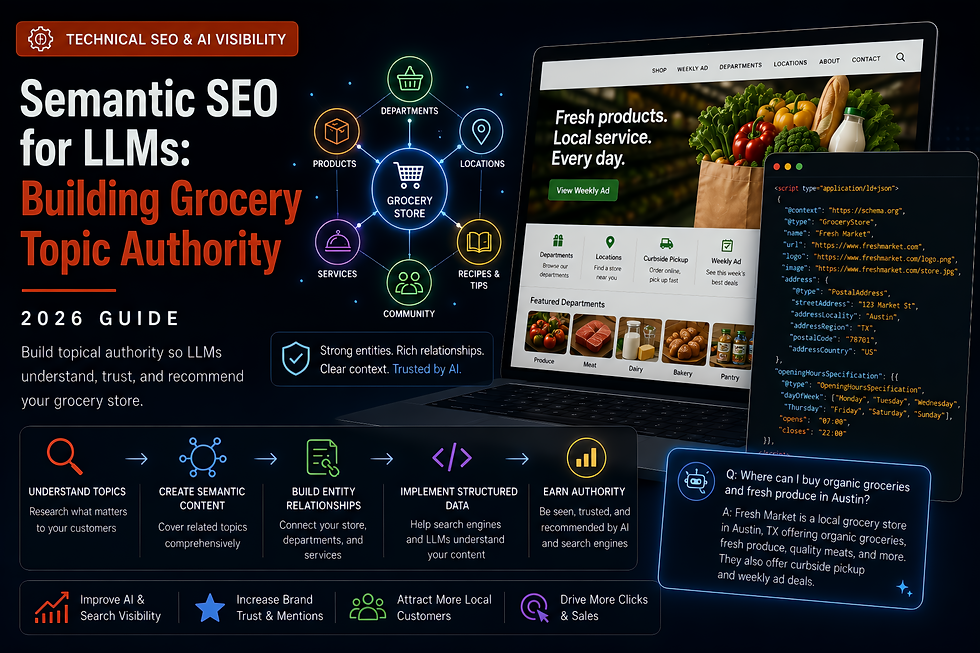
Semantic SEO for LLMs: Building Grocery Topic Authority
Grocery Store Department Page SEO
Grocery Store Location Page SEO
SEO for Specialty Food Stores
Retrieval, RAG & Citations
LLM Retrieval Optimization: Making Grocery Content Easier for AI to Find
RAG and Grocery Store Websites: What Retailers Need to Know
Citation Optimization: How to Make Your Grocery Store More Citable by AI
LLM Optimization for Grocery Stores
Entities & Authority
Entity Optimization for Grocery Stores
How Grocery Stores Can Build Entity Authority for LLM Search
Knowledge Graph Optimization for Grocery Stores
How LLMs Understand Grocery Store Brands, Locations & Departments
How LLMs Choose Which Grocery Stores to Recommend
GEO & AEO
GEO for Grocery Stores
Grocery Store GEO Checklist
AEO for Grocery Stores
Grocery Store AEO Checklist
GEO vs SEO for Grocery Stores
Grocery AI Search Optimization
Technical AI Optimization
Structured Data for LLM Optimization: A Grocery Store Guide
Schema Markup for Grocery Store AI Search & LLM Visibility
Schema Markup for Grocery Stores
Comments